
The U of T computer science faculty member has been named a 2026 AI2050 Early Career Fellow by Schmidt Sciences.
Sheila McIlraith receives Test of Time Award for research on intelligent agents
Thomas Ristenpart receives USENIX Security Test of Time Award
Putting students first: Harry Sha and Pan Chen earn inaugural DCS Graduate Teaching Award
For Harry Sha, exceptional teaching means inspiring lasting curiosity. For Pan Chen, it’s about helping students learn in ways that go beyond simply absorbing course content. Though their definitions differ, both University of Toronto computer science PhD candidates share a commitment to creating meaningful learning experiences.
U of T CS researcher earns national dissertation award for advancing menstrual health technology
Supervisor and student recognized for advancing health-focused HCI
A focus on health-oriented human-computer interaction (HCI) has shaped the research journeys between Associate Professor Alex Mariakakis and his former PhD student, Blue (Georgianna) Lin. That shared trajectory is now reflected in their recognition at the 2026 Graphics Interface Conference.
Alice Gao’s supportive approach earns Faculty of Arts & Science Outstanding Teaching Award — Early Career
Raquel Urtasun elected Fellow of the Royal Society
Professor Emeritus Eugene Fiume honoured with Lifetime Achievement Award by CS-Can | Info-Can
CS student leads U of T at Putnam Math Competition and earns U of T Excellence Award
Boyan Litchev was the highest University of Toronto scorer at the 2025 William Lowell Putnam Mathematical Competition, a prestigious contest for undergraduate students across Canada, the U.S. and Mexico. The competition awards scholarships and cash prizes of up to $2,500 to top students and up to $25,000 to top schools.
Game on: U of T computer science students level up at the 2026 showcase
For developing interdisciplinary data sciences courses, faculty receive distinguished Northrop Frye Award
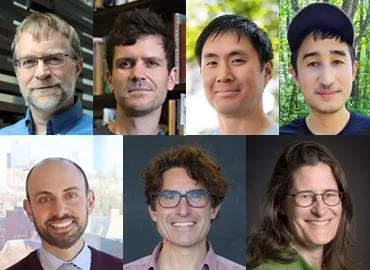
Top (l. to r.): Paul Gries, Adam Hammond, David Liu, Tomomi Parins-Fukuchi; bottom (l. to r.): Michael Widener, Nathan Taback, Mary Pugh.
The prestigious Northrop Frye Award, one of the university’s Awards of Excellence, has been bestowed on the Interdisciplinary Data Science Course Development Team for the creation of three introductory data science courses for students across the faculty — particularly students without a traditional computational or quantitative background.
The team, which includes seven instructors from the humanities, social sciences, life and mathematical sciences, combined their disciplinary and pedagogical expertise to create learning experiences that give students skills applicable to any career, that nurture a critical approach to problems, and that equip them to think outside traditional methods of analysis. The results are innovative courses designed to prepare students to tackle today’s complex challenges.
The courses are: ENG286H1 — Literature and Data; GGR274H — Introductory Computation and Data Science for the Social Sciences; and EEB125H1 — Introductory Computation and Data Science for the Life and Physical Sciences.
The team includes:
Professor Paul Gries, Teaching Stream, Computer Science
Associate Professor Adam Hammond, English
Professor David Liu, Teaching Stream, Computer Science
Professor Tomomi Parins-Fukuchi, Ecology & Evolutionary Biology
Professor Mary Pugh, Mathematics
Professor Nathan Taback, Teaching Stream, Statistical Sciences
Professor Michael Widener, Geography & Planning
The initiative emerged from the Faculty of Arts & Science Computational and Data Studies Working Group that was established to address growing student demand for computational and data-related learning beyond the departments of Computer Science and Statistical Sciences.
U of T’s Awards of Excellence program has recognized exceptional students, faculty, librarians and administrative staff members since 1921. Though the criteria differ for each of the awards in the suite, recipients all share a commitment to enhancing the university experience of their peers and leave a significant impact on the university through their efforts.
“The award recognizes a deeply interdisciplinary and sustained collaboration that has transformed how students across Arts & Science encounter computation and data analysis,” says Karen Reid, professor, teaching stream in the Department of Computer Science, who nominated the team.
“The sustained impact on student learning, combined with the team’s deep interdisciplinary collaboration and commitment to pedagogical innovation, exemplifies the values recognized by the Northrop Frye Award.”
According to Faculty of Arts & Science vice dean, undergraduate Randy Boyagoda, “These three courses demonstrate that when data science education is designed intentionally — grounded in accessibility, interdisciplinarity and ethical awareness — students from across the faculty eagerly and successfully engage with it.
"Students who take these courses will leave university with greater confidence in knowing how data science works, which will matter to their personal and professional lives and make them all the more willing and able to be good contributors to our shared public life,” says Boyagoda, who is also the university’s provostial advisor on civil discourse and a professor in the Department of English.
The success and impact of the team’s work is reflected in a typical student’s feedback: “With its intersection with computer science and traditional English studies, ENG286 prepared me to think about how developing technologies such as AI and an ever-expanding digital marketplace and database can both enrich traditional legal views while also criticizing and promoting new ways to view precedents.”
Original story by A&S News
Steve Engels receives U of T's Joan E. Foley Quality of Student Experience Award
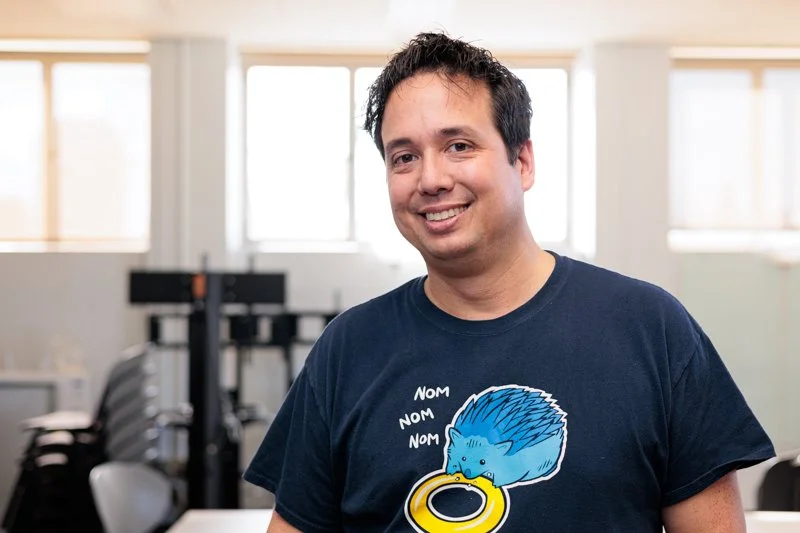
Photo: Matt Hintsa
Steve Engels, a professor, teaching stream in the University of Toronto's Department of Computer Science, has received the Joan E. Foley Quality of Student Experience Award — one of the university's highest honours recognizing contributions to undergraduate and graduate student life.
Presented annually by the U of T Alumni Association, the $1,000 prize goes to a student, faculty or administrative staff member who has made a distinctive and lasting contribution beyond the expectations of their role. Engels was recognized for his work building video game design education and experiential learning opportunities that have shaped the academic paths of hundreds of students.
In 2007, Engels created CSC404: Introduction to Video Game Design, a course that draws students from Computer Science, OCAD University and U of T's Faculty of Music to collaborate in multidisciplinary teams. In a 2024 interview, Engels recounted creating the course after a student expressed interest in game design. Many first-year students now cite CSC404 as a reason they chose to study computer science at U of T.
The course became the foundation for the Level Up Showcase, which Engels co-founded in 2011 with collaborators from OCAD University and Ontario Tech University. What began as a modest end-of-term exhibition has grown into one of the largest student game showcases in Ontario, drawing more than 4,000 attendees in 2025 and featuring teams from more than 20 colleges and universities. Industry partners including Ubisoft and Zynga participate as judges and audience members, giving students direct exposure to professional networks and career opportunities.
Beyond the classroom and showcase, Engels has developed research and outreach experiences that connect students to real-world applications of game design. Through partnerships with the Royal Ontario Museum, Toronto Rehab Institute, the Institute of Forensic Sciences at U of T Mississauga, U of T’s Ontario Institute for Studies in Education (OISE) and various community organizations, students have contributed to projects ranging from museum interactive exhibits to rehabilitation tools and educational games.
"Steve's work exemplifies what it means to go above and beyond for students," said Eyal de Lara, professor and chair of the Department of Computer Science. "From a single course to a province-wide showcase and a network of community partnerships, he has built something that continues to open doors for students long after they leave the classroom."
The Joan E. Foley Award is named in tribute to the late Joan Foley, who served as the first female Provost of U of T and first female Principal of U of T Scarborough. It is presented as part of the university's annual Awards of Excellence.
CS Professors Tovi Grossman and Karan Singh receive Connaught Innovation Awards
Jennifer Campbell named ACM Distinguished Member
Marsha Chechik honoured with A&S Dean’s Research Excellence Award
Sushant Sachdeva wins Connaught Fund’s McLean Award for work in fast algorithms and graph optimization
U of T establishes new Hinton Chair in Artificial Intelligence thanks to generous support from Google

Geoffrey Hinton at U of T’s St. George campus. Photo by Nick Iwanyshyn.
The University of Toronto is proud to announce that it has established the Hinton Chair in Artificial Intelligence, made possible by $10 million in funding from Google.
This new chair will honour the extraordinary legacy of University Professor Emeritus and Nobel laureate Geoffrey Hinton at U of T and Google by enabling the university to recruit and retain another brilliant, internationally recognized AI expert to make profound contributions to the field.
“On behalf of the university, I would like to express our deepest gratitude to Google for this wonderful investment,” said Melanie A. Woodin, University of Toronto president. “This new chair will enable us to build on Geoff Hinton’s historic contributions in artificial intelligence and to advance our record of transformational research in fields of crucial importance to the world.”
U of T is matching Google’s support with an additional $10 million in funding. This historic $20-million investment makes the Hinton Chair in Artificial Intelligence one of the University of Toronto’s most prestigious and generously supported advanced research roles, with substantial endowed support for a leading-edge AI researcher and additional funds to drive fundamental discoveries and insights — creating the intellectual underpinnings necessary to take AI to the next level.
“Google is proud to partner with the University of Toronto in establishing this endowed chair, recognizing the extraordinary impact of Geoff Hinton, whose Nobel Prize-winning work laid the foundation for modern artificial intelligence,” said Jeff Dean, chief scientist at Google DeepMind and Google Research. “On a personal level, it was a delight to have Geoff as a colleague for more than a decade. This chair will empower world-class academic scholars to accelerate breakthrough innovations and drive responsible research that shapes a future where AI serves a common good.”
The Hinton Chair is the first in the university’s newly developed Third-Century Chairs program, a strategic effort established on the cusp of U of T’s bicentennial to attract and retain visionary scholars who can transform disciplines, shape global discussions, improve lives and strengthen Canada’s capacity to prosper. With competition for talent at an all-time high, the program will help the university amass critical expertise in areas essential to the country’s future — a key priority shared by the Canadian government, which recently announced a $1.7-billion commitment to attract top global research talent.
The Hinton Chair will also help U of T recruit, teach and train some of the world’s most talented students in the field, fuelling innovation in AI applications across medicine, engineering, discovery science, the humanities and more, expanding the university’s AI networks and international partnerships and sparking a new wave of promising AI startups.
Building on Hinton’s revolutionary research
The Hinton Chair in Artificial Intelligence aims to support the same brilliant, exploratory research that its namesake has pursued during his time at the University of Toronto and at Google.
After receiving his PhD in Artificial Intelligence from the University of Edinburgh in 1978 and completing several years of postdoctoral work in the United Kingdom and the United States, Geoffrey Hinton came to the University of Toronto in 1987 as a fellow of the Canadian Institute for Advanced Research (CIFAR). There, along with several graduate students, he accelerated his expansive work on artificial neural networks as a potential pathway for advancing AI, developing core concepts such as: backpropagation algorithms; distributed representations; time-delay neural nets; mixtures of experts, variational learning and deep learning; and, most famously, Boltzmann machines.
In the 2000s, Hinton’s ideas began to yield extremely promising results. In March 2013, as more tech companies recognized the promise of artificial neural networks, Hinton joined Google as a vice president and engineering fellow, where he would stay for the next decade, splitting his time between the company and U of T.
Although many people have contributed to the current state of AI, arguably none was more important than Hinton, whose decades-long research forms the foundation of modern artificial intelligence and its myriad applications across nearly every discipline and sector. He is also responsible for the “Hinton effect,” which saw many of his students go on to lead AI advances in universities and companies across the globe.
“I am grateful for having been able to pursue my research at the University of Toronto, which afforded me the time and resources to develop the ideas that would eventually grow into the success of neural nets,” said Geoffrey Hinton. “I am encouraged that the Hinton Chair in Artificial Intelligence will support the next generation of AI research in the same vein, allowing ideas of great promise to germinate for the benefit of all humanity.”
Together with John J. Hopfield, Hinton won the Nobel Prize in Physics in 2024 for his foundational work in enabling deep learning and propelling the field to its current peak.
University of Toronto — a world leader in AI
Based at the Faculty of Arts & Science’s Department of Computer Science — ranked 12th in the world according to the 2025 QS World University Rankings by Subject and a global leader in deep learning and generative AI — the Hinton Chair in Artificial Intelligence will leverage U of T’s and Toronto’s substantial and widely recognized strengths in AI.
“It’s thrilling to consider the astonishing possibilities of welcoming a globally leading AI researcher into this setting,” said Interim Dean, Faculty of Arts & Science Stephen Wright. “At the Department of Computer Science, the chair-holder will be surrounded by a remarkable concentration of scientific knowledge and creative skills, and a deep, proven track record of research excellence. It’s an ideal platform for charting new pathways and pursuing breakthrough discoveries in our shared goal of a brighter technological future for all.”
The University of Toronto is home to CIFAR AI Chairs and Canada Research Chairs in AI and has spurred several cutting-edge AI startups such as BlueDot (infectious disease intelligence), Waabi (autonomous trucks) and Deep Genomics (RNA-focused AI for disease detection). In addition to Hinton’s Nobel Prize, U of T’s faculty members and graduates have earned many other distinctions, including two Turing Awards, two of the three Herzberg Gold Medals ever awarded to computer scientists, and 15 Sloan Research Fellowships.
The university also consistently attracts and trains the best and most diverse cohort of undergraduate and graduate students from around the world, with hundreds pursuing AI-related studies across the university.
In addition, U of T is home to an array of AI-focused research initiatives such as the Acceleration Consortium, the Schwartz Reisman Institute for Technology and Society, the Data Sciences Institute and the Temerty Centre for AI Research and Education in Medicine. The university also maintains a close partnership with the Vector Institute, a globally renowned organization co-founded by Geoffrey Hinton that empowers researchers, businesses and governments to develop and adopt AI responsibly.
An impactful partnership: Google and U of T
Establishing the Hinton Chair in Artificial Intelligence is the latest instance of U of T and Google’s longtime partnership in supporting discovery-based research. Over the years, Google has engaged many AI-focused U of T alumni and academic leaders, including Hinton, and the two organizations are founding partners in Toronto’s Vector Institute. Previous funding from Google has helped position the University of Toronto as a preeminent centre for advanced research in AI, and this new chair will greatly expand this impact.
“We are extremely grateful to Google for partnering with us to establish a chair dedicated to cutting-edge research on the defining technology of our time, which will help generate societal and economic benefits for communities across the planet,” said David Palmer, U of T vice-president, advancement. “Hinton himself once said that real breakthroughs come from people focusing on what they’re excited about, and the Hinton Chair will honour this example by providing unprecedented support for the next era of elemental, curiosity-driven work in artificial intelligence.”
— Original story by the University of Toronto