
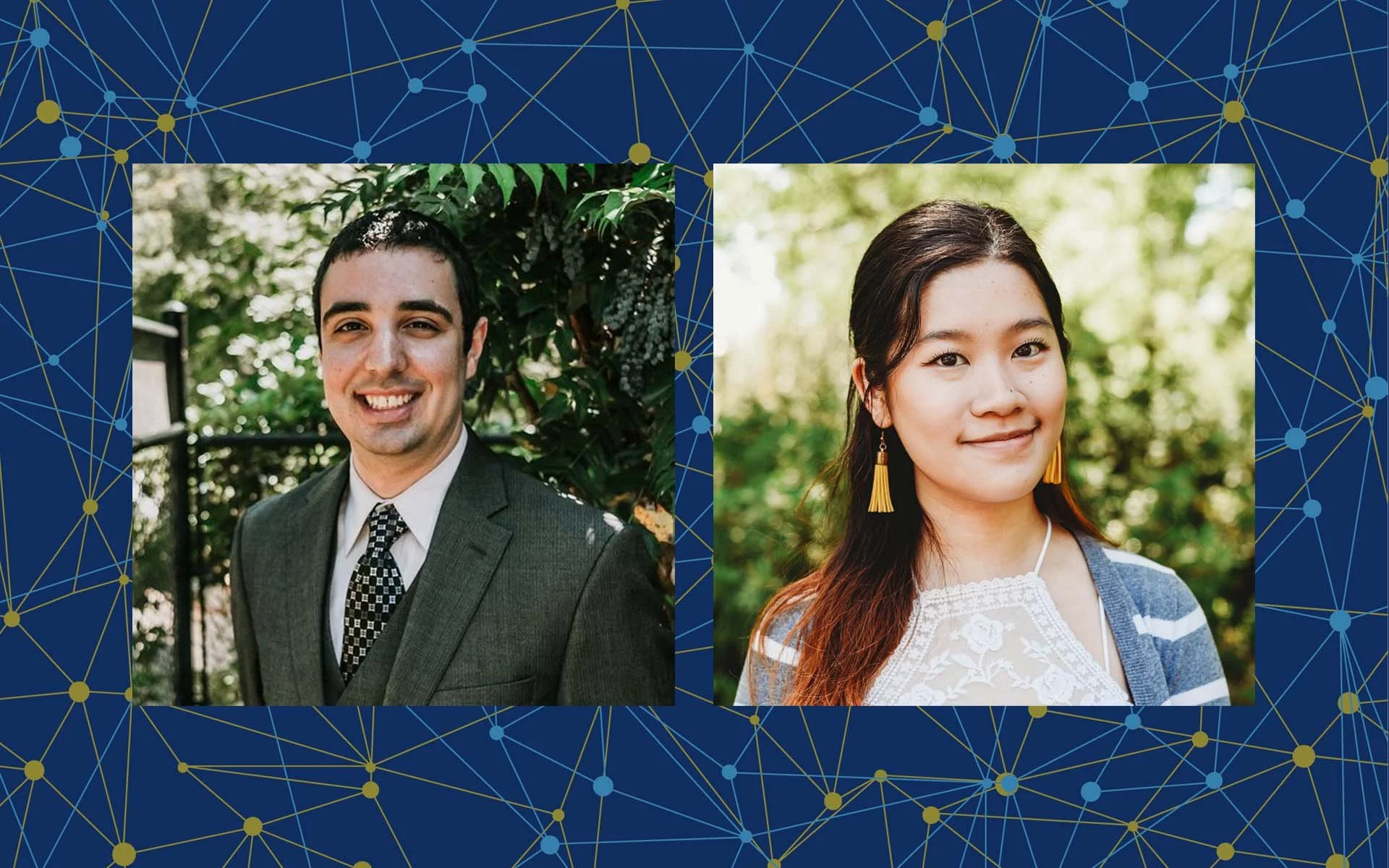
From left to right: Associate Professor Alex Mariakakis and PhD graduate Blue (Georgianna) Lin.
A focus on health-oriented human-computer interaction (HCI) has shaped the research journeys between Associate Professor Alex Mariakakis and his former PhD student, Blue (Georgianna) Lin. That shared trajectory is now reflected in their recognition at the 2026 Graphics Interface Conference.
Mariakakis received the CHCCS/SCDHM Graphics Interface Early Career Researcher Award. Lin was awarded the Bill Buxton Outstanding Doctoral Dissertation Award — named after the U of T computer science alum and HCI pioneer.
“It’s a great honour, but I couldn’t have gotten this award without the excellent work of students like Blue,” says Mariakakis. “My recognition is more of a recognition of her work and the other students involved.”
Lin, meanwhile, says the award she received is particularly meaningful because it validates her research in menstrual and women’s health within the computing community.
“There were moments when people, even with the best intentions, labelled my research as ‘niche,’” she says. “I often had to justify the tech as awesome before I could say, ‘This is why you should care about the domain.’ So, what’s amazing about this award is that it validates that the computing community is interested in both the tech and the domain.”
Designing tools for menstrual health sensemaking
Completed under Mariakakis’s supervision, Lin’s dissertation — Multimodal Tracking with Ubiquitous Devices to Foster Holistic Menstrual Health Sensemaking — examines how combining data from multiple sensors and health signals can help people better understand complex, long-term personal health information.
Focusing on menstrual health, an area historically underserved in HCI, her research argues for tools that move beyond simplified, calendar-based models of the menstrual cycle toward more personalized and holistic understandings grounded in lived experience.
“I came into this space because I was wondering why my period tracker predictions were inaccurate for me,” says Lin. “I initially thought it was an algorithm or data problem, but I realized it’s not just that. It’s a systemic problem.”
This realization, Lin says, informed her approach to the research. She designed two longitudinal studies that combined hormonal data, sensor readings, and detailed symptom tracking over extended periods, alongside interviews and workshops.
Her findings suggest the challenge is not simply collecting more information, but helping people understand what their bodies are already signalling.
“People didn’t know that every day is part of the menstrual cycle, or what the relationship between their cycle and things like heart rate or body temperature could be. That is a literacy gap,” she says. “So, while the next most relevant step is to create a tool that’s highly accessible and helps people interpret this kind of information, tech alone is not enough to move the needle. It won’t help if society continues to stigmatize menstrual health. It has to be a multidisciplinary effort.”
Translating health research into real-world systems
Mariakakis’s research at the intersection of health and HCI similarly emphasizes applied systems that leverage pervasive technologies, such as smartphones and wearables, to address health problems. His work spans top HCI venues and industry applications alike, earning multiple paper awards and resulting in several patents.
“I subscribe more to a model that keeps humans in the loop,” he says. “A lot of technology in healthcare gives autonomy to systems, but I think you have to consider everyone involved — clinicians, patients, and caregivers.”
One area of Mariakakis’s research, for example, explores how noise-cancelling earbuds can capture heart sounds via built-in microphones. Working with clinical partners, his lab is investigating how these signals could be used to estimate blood pressure and support remote monitoring for people with heart-related conditions, particularly in telehealth settings.
“I am a co-author on many of the projects,” says Mariakakis, who leads the Computational Health and Interaction Lab at U of T. “Ultimately, it’s my students doing great work, and hopefully there’s more to come from my other students in receiving awards.”