
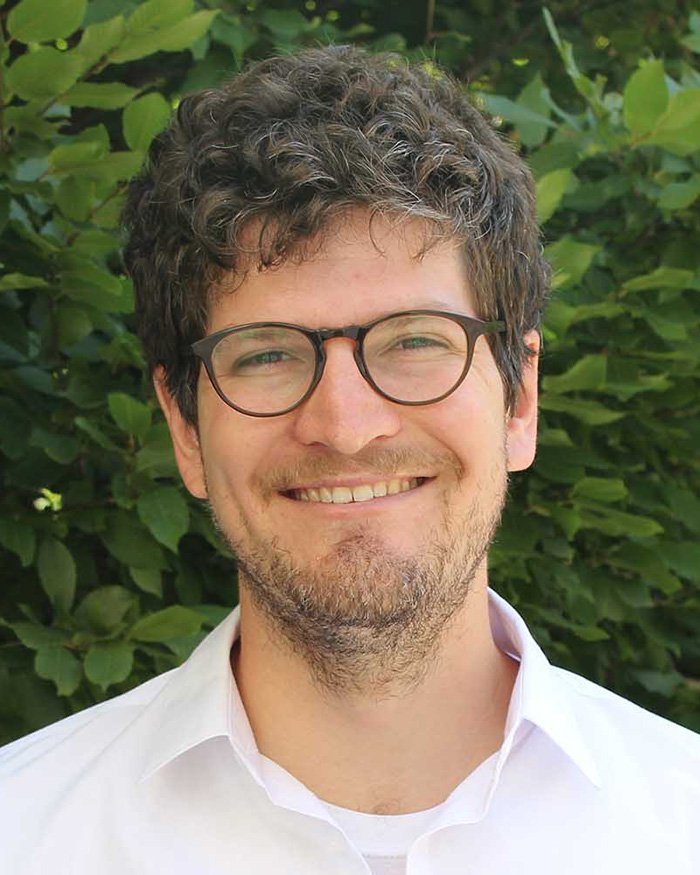
Associate Professor Alec Jacobson
Alec Jacobson’s interest in geometry began with its connection to the physical world: a geometric object can exist as both a mathematical idea and something you can see, manipulate or even hold in your hand. That fascination has evolved into a research career in geometry processing and related fields.
Now, Jacobson, an associate professor in the University of Toronto’s Department of Computer Science, has been elected to the Royal Society of Canada’s (RSC) College of New Scholars, Artists and Scientists.
The RSC is Canada’s national academy, and its college recognizes emerging Canadian intellectual leaders for their expertise, innovation and contributions to developing fields and complex challenges.
“It feels great to get recognition from my broader colleagues in academia,” says Jacobson, one of six new RSC college members from U of T. “It’s an honour for me, and it’s a reflection of the work that my students and I have been doing over the last decade at U of T.”
Turning geometry into tools
Jacobson, also a Canada Research Chair in Geometry Processing, has spent years exploring how computers can represent, manipulate and work with geometric shapes. His work has applications in art, design, engineering and manufacturing.
Developing tools that others can use is an important part of that work. Jacobson has co-developed open-source software, including the geometry-processing library libigl, which is widely used in academia and industry — sometimes in unexpected ways.
“One of our most successful projects tackled the problem of determining what’s inside and outside a 3D shape,” Jacobson says. “The community then took that work and applied it to scanned data, using it to reconstruct surfaces in a way that was related to the original problem but not how we had approached it.”
Looking ahead, Jacobson — who will be inducted into the RSC this November — is turning his attention to AI’s disruption of the creative process. He will explore how AI tools might become something artists embrace rather than view as adversarial.