
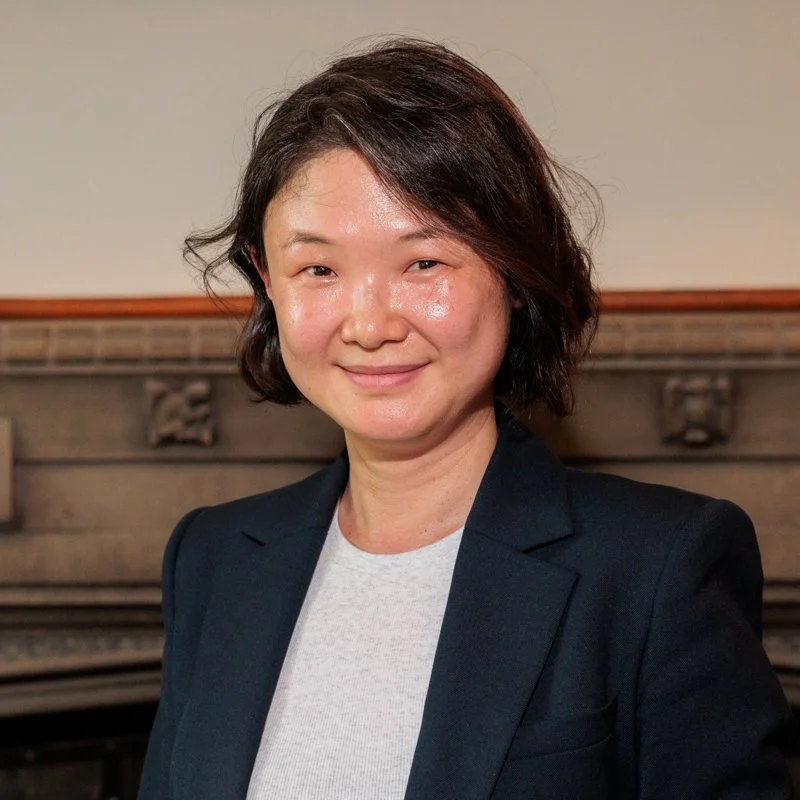
Alice Gao (Photo: Matt Hintsa)
Alice Gao, a recipient of the University of Toronto’s Faculty of Arts & Science Outstanding Teaching Award —Early Career, still remembers a moment that solidified for her why teaching matters.
A student struggling through a demanding programming course while facing personal challenges came to Gao for help. During the conversation, the Department of Computer Science assistant professor, teaching stream, offered the student the opportunity to submit missed assignments.
“When I told her she had a second chance, she started crying. She had been trying to hold so much,” says Gao. “She passed the course, and after graduating, she emailed me to say I was one of the professors who motivated her to pull her GPA back up.”
For Gao, the experience highlighted an important lesson: effective teaching is as much about creating an environment where students feel supported through setbacks as it is about teaching technical concepts.
It’s a philosophy that has helped lead to the Outstanding Teaching Award — Early Career, which recognizes faculty members for teaching excellence in graduate or undergraduate education with a focus on classroom instruction and course design and/or curriculum development.
“It feels very reassuring to receive this award,” says Gao. “It reminds me that I’ve been making a difference in my students’ lives. It’s also a huge encouragement to keep doing this work.”
From expert to educator
Before joining U of T in 2022, Gao was a computer science lecturer and advisor at the University of Waterloo. She earned her PhD in computer science from Harvard University and completed her postdoc at the University of British Columbia, where she first discovered a passion for teaching as an instructor.
“I really enjoyed explaining something to students and seeing the ah-ha moment,” she says. “The joy I felt in those moments made me consider it as a career.”
Teaching also came with a learning curve. Gao quickly realized that being an expert in a subject and teaching it effectively were two different skills. Early feedback prompted her to rethink how she engaged students.
Building a supportive classroom
Those lessons continue to shape Gao’s approach today. During her first lecture each term, Gao shares her own journey — including the challenges and detours.
“Learning is a vulnerable process, and I want students to feel safe to struggle,” says Gao, who teaches advanced undergraduate courses in artificial intelligence and machine learning. “So, I show up as my authentic self and build genuine connections with my students. I also encourage them to be curious and resilient.”
To make complex concepts more accessible, meanwhile, Gao combines mathematical explanations with analogies, real-world examples and visualizations. She also incorporates active learning throughout her lectures, using tools such as Mentimeter to encourage participation.
“It’s not a traditional raise-your-hand-and-answer-questions classroom,” she says. “Allowing students to participate anonymously makes participation more inclusive.”
Gao even taps into her own research in time management and computer science education. In one course, she breaks large programming assignments into smaller checkpoints, giving students opportunities to receive feedback along the way and helping them develop stronger lifelong learning habits.
“I focus on self-regulated learning, so learning to learn,” she says. “Students may forget some of the technical content later on, but these skills will help them pick up new tech knowledge throughout their careers.”