
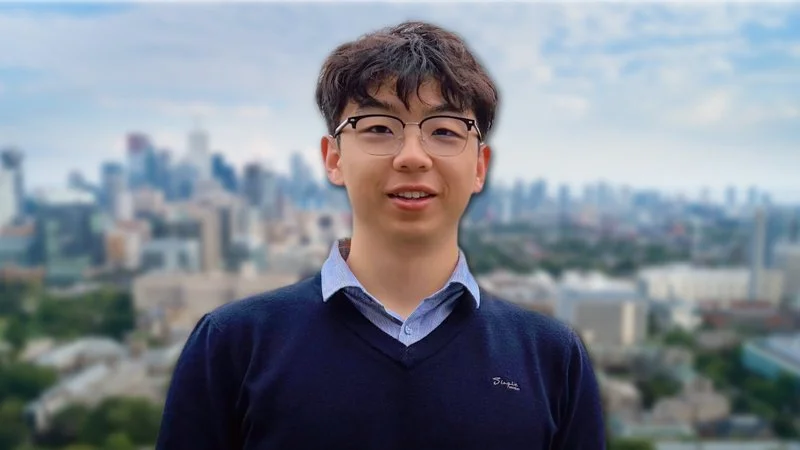
Yuchen Wang
Computer Science Specialist
St. Michael’s College
Yuchen Wang’s undergraduate research focused on applying artificial intelligence in healthcare, with work spanning Toronto Rehab and the Vector Institute. Working closely with clinicians and real patient data, he developed a strong interest in building practical, patient-centred solutions.
Now, he is continuing that work in graduate studies, focusing on technologies that drive meaningful impact in clinical settings.
This Q&A has been edited for clarity and length.
Your work spans both Toronto Rehab and the Vector Institute. How did those experiences shape your approach to applying AI in healthcare?
My first research experience began at Toronto Rehab, where I was fortunate to receive funding from the Data Sciences Institute. There, I focused on extracting valuable insights from data to support recovery for patients with spinal cord injuries. Through this work, I learned the importance of developing solutions that are practical, interpretable and centred on patient needs.
Thanks to the research opportunities provided through the Department of Computer Science at the University of Toronto, I later joined the Vector Institute, where I strengthened my research and analytical skills through exposure to advanced computational methods and interdisciplinary collaboration. Together, these experiences shaped my goal of building technologies that create meaningful impact in clinical settings.
You’ve worked closely with clinicians and real patient data — how did that influence the kinds of problems you chose to focus on?
Working closely with clinicians and real patient data helped me focus on problems with clear clinical relevance and practical impact. I became especially interested in developing methods that could produce interpretable and reliable insights rather than simply optimizing performance metrics. These experiences showed me that meaningful healthcare technologies must address real challenges faced by both patients and care providers.
What first drew you to computer science, and was there a moment during your degree when you knew you’d made the right choice?
I was first drawn to computer science when I realized its power to uncover significant insights from massive amounts of data. I knew I had made the right choice during my work at Toronto Rehab, where I saw how my research could help patients recover faster and more effectively. That experience showed me how computational research can create tangible impact in healthcare and improve real patient outcomes.
If you could give one piece of advice to a first-year computer science student, what would it be and why?
I encourage first-year computer science students to go beyond the classroom and seek opportunities to apply what they learn to real-world problems.
I would also encourage them to find an area they are genuinely passionate about and stay committed to it, because long-term curiosity and persistence drive the most rewarding work.
What are your interests outside of computer science?
Outside of computer science, I enjoy playing badminton. I also love reading books in my spare time, as it allows me to explore new perspectives and continue learning beyond academics.
What’s next for you, and how does computer science fit into that?
This fall, I will begin the Master of Science in Computer Science program at Stanford University, where I hope to further strengthen my technical skills. Computer science will continue to be an important part of my academic and professional journey, especially as I work toward building technologies that can solve real-world problems.