
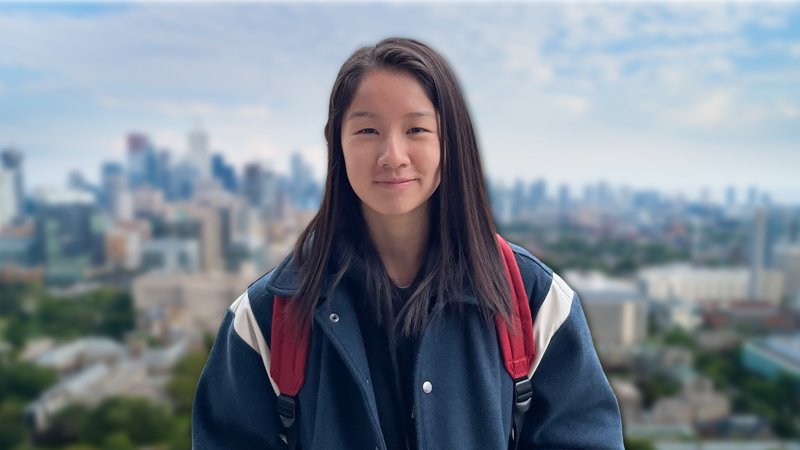
Kelly Zhu
MSc in Computer Science
Kelly Zhu combines computer vision, robotics and AI to build systems that make complex phenomena visible. Her path to research began with a hands-on experience that sparked an interest in open-ended problem solving and grew into an MSc at the University of Toronto, where she worked across disciplines and explored applications in imaging and autonomous technologies.
Now, as she prepares to begin her PhD at Carnegie Mellon University, Zhu reflects on the impact of curiosity-driven work and the foundation it creates for what comes next.
This Q&A has been edited for clarity and length.
Your work brings together computer vision, robotics and AI. What do you enjoy most about working across these areas?
What I love most about working in computational imaging, computer vision and AI is the ability to visually see the impact of my work. There's something very exciting about capturing and visualizing phenomena through novel sensors and algorithms in ways that have not been done before.
You've received several awards during your MSc, including the Vector Scholarship in AI. How did those opportunities shape your experience?
During my MSc, I was very fortunate to receive several graduate scholarships, including OGS, QEII-GSST and the Vector Scholarship in AI. I appreciate the support they provided. They allowed me to focus on my research and gave me the confidence to make meaningful contributions to the field early in my graduate journey.
The Vector Scholarship also helped me connect with Ontario's AI community. Through the Vector Institute, I built many meaningful connections that I wouldn't have found otherwise.
Your research connects to real-world systems like imaging and autonomous technologies. What excited you most about seeing your work applied in practice?
What excites me most about working in imaging is knowing the systems we design can support many downstream applications, including autonomous technologies, scientific visualization, medicine and beyond. Exploring these applications during my MSc gave my work an interdisciplinary scope and allowed me to learn and collaborate across different fields.
Knowing that my research has the potential to contribute to real-world systems gives it a deeper sense of purpose and impact.
What first drew you to computer science, and what led you to pursue it at the graduate level?
After my first year of undergrad, I worked in a research lab at U of T on an autonomous bed-making robot. I loved the open-endedness of defining a research problem and navigating my own path to a solution.
That experience made it clear that I wanted to pursue research more deeply, so graduate school felt like a natural next step.
If you could give one piece of advice to a student considering graduate studies, what would it be and why?
“Take advantage of the many research opportunities available over the summer. There are many incredible programs at the University of Toronto and abroad, and they offer a great way to explore academic interests beyond the classroom.”
Some of my most meaningful undergraduate experiences came from those summers spent doing research, so I encourage students to not be afraid to apply broadly. Shoot your shot!
What are you most proud of accomplishing during your time at U of T — whether in your research, collaborations or academic journey?
I am most proud of the incredible network of friends, peers, collaborators and mentors I built during my time at U of T. My accomplishments throughout both my undergraduate and graduate studies would not have been possible without their support and guidance. It's inspiring to see the remarkable paths everyone goes on to build for themselves after graduation.
I'm also proud of the research skills I've developed along the way, which will serve as a strong foundation for whatever comes next.
What's next for you, and how do you see your work in computer science shaping that path?
This fall, I will start my PhD at Carnegie Mellon University. I look forward to continuing my research in computer vision and pushing the frontiers of what machines can perceive and understand.