
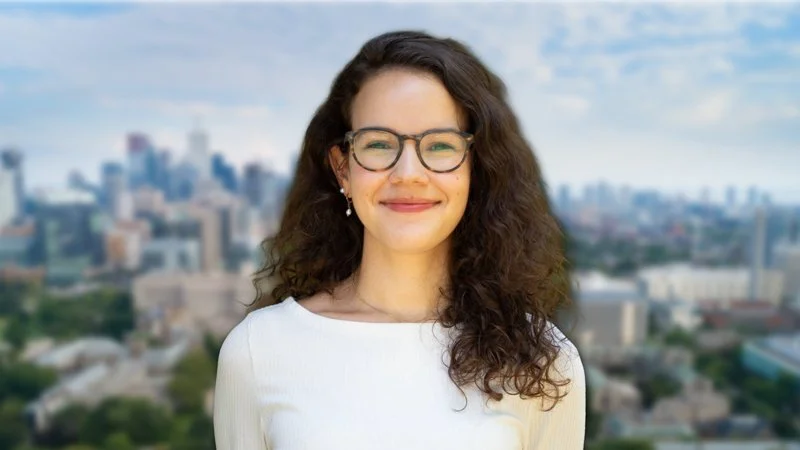
Helena Glowacki
Computer Science Specialist
University College
Blending computer science with creativity and community, Helena Glowacki shaped her undergraduate experience through research, student storytelling and artistic interests. Her path reflects a curiosity about how technology connects with human expression.
Now, she is continuing her studies in computer science, focusing on human-AI interaction and the role of technology in creative work.
This Q&A has been edited for clarity and length.
You’ve contributed to the In the Loop podcast — what drew you to that platform, and what did you enjoy most about being part of it?
I discovered the podcast during my Arts & Science Internship Program (ASIP) internship when I was trying to figure out how to make the most of my final year at U of T, and I ended up listening to every episode in one sitting. Each episode introduces a new topic by bringing together faculty and student perspectives. Even when a topic didn’t directly align with my technical interests, it felt genuine and easy to connect with, so I kept listening.
The Grad School 101 episode especially inspired me to consider graduate studies as a pathway. After working on the podcast, what I enjoyed most was collaborating with Professors Mario Badr and Diane Horton. Their joy and passion are infectious, and I feel grateful I had the chance to work with them.
If you’re a current or prospective CS student, I highly recommend checking out the podcast @uoftintheloop on Instagram! :)
Alongside your work in CS, you’re also involved in the student orchestra — how do your creative and technical interests intersect?
Creative arts have always been a big part of my life, through music and visual arts, and I’ve loved how naturally they connect with computer science through areas like graphics, video game design and UI design. As AI advances quickly, that intersection has become even more important to me.
I’m currently working with undergraduate student Sarah Wang, PhD student Harsh Kumar and Professor Ashton Anderson on research that explores how LLMs may shape emotional expression and the creator-audience relationship. This work made me think about how we can better design AI systems that support, rather than replace, human creativity, and it’s something I hope to keep exploring.
What first drew you to computer science, and was there a moment during your degree when you knew you’d made the right choice?
I took my first computer science course as an elective in high school. It’s hard to explain, but I liked how solving a computer science problem felt different from solving a pure math question or working through other STEM subjects — it felt more like solving a riddle than following a set process.
In university, I never had a single moment where I realized I’d made the right choice. Instead, I'll always remember and cherish the incredible support from the teaching team and CS community, along with the freedom we had to explore. People were excited to hear new ideas and to see each other grow.
If you could give one piece of advice to a first-year computer science student, what would it be and why?
Find your community! U of T is a huge school, and while that can feel overwhelming, it also means there are many opportunities to make friends and build a support system. If there is something that excites you or you want to try something new, whether it's related to computer science or not, there is a way to pursue it.
Of course, make time for your studies, but having a place where you can be and express who you are makes it easier to face the challenges along the way.
What are your interests outside of computer science?
Outside of computer science and the creative arts, I’ve grown to enjoy marketing because of how closely it connects to building communities and helping people feel connected. One of my favourite experiences during my degree was serving as marketing director for the Women in Science and Engineering National Conference in my third year.
In the months leading up to the conference, I built our platform for outreach and engagement, and it was incredibly rewarding to see that work come to life as more than 400 delegates from across Canada joined us. More than anything, I loved watching people connect, find their community and form new friendships over the weekend.
Although marketing sits outside computer science, I’ve noticed it is increasingly shaping how I approach and share my technical work.
What's next for you, and how does computer science fit into that?
This fall, I’ll return to the U of T Department of Computer Science to begin the MSc in Computer Science program! I’m excited to work with Professor Fanny Chevalier in human-AI interaction, building on her work in HCI.