

Computer Science alumnus Ben Vinegar is the co-founder and CEO of Modem. (Photo credit: All photos provided by Ben Vinegar)
Ben Vinegar's first foray into entrepreneurship was setting up an online bulletin board. He scoured the internet for shareware files and hosted them on his hard drive for visitors to download.
Vinegar, who is now the co-founder of an AI product management software startup called Modem, recalls promoting his bulletin board on forums and soliciting donations.
“After months and months of doing this, I think I made $15,” says Vinegar, who earned his honours bachelor of science in 2006 studying computer science as a member of University College. “That was a great experience as a young person. It taught me it's really hard to make a dollar.”
Vinegar's bulletin board beginnings helped inspire the name Modem, after the trusty piece of hardware that connected his home network to his internet provider. Today, the A&S alum is still connecting people through technology, though on a much larger scale.
Modem is an AI auto-triage system, tracking feedback across customer support platforms to identify pain points with features as companies roll them out. This creates a feed of the biggest concerns the customers face and helps developers follow up and engage with their customers to address the problem.
“At scale, knowing what people care about is hard,” Vinegar says. “We help software companies make better decisions about what to build for customers and how to deliver on it.”
Founding Modem has been a challenging and rewarding experience for Vinegar, who says it's easy to take for granted all the problems that have already been solved when you join a company.
“As a founder, the buck stops with you,” Vinegar says. “The upside is you get to be creative and try things.”
As an undergraduate at A&S, Vinegar didn't necessarily have his sights set on building his own company. He did, however, discover how much he enjoyed learning from customers and building software to suit their needs.
One formative experience was in a course led by Greg Wilson, then an assistant professor of computer science. Wilson gave students the opportunity to develop software to help companies or different departments within the university.

Vinegar (right) with Modem co-founder Mike Clarke.
Vinegar remembers working with Professor Nicholas Provart at the Department of Cell & Systems Biology. Vinegar's project visualized gene expression data of a plant under different circumstances, and the work eventually went live on the department's website.
“I got to act as a consultant, learning about the problem and developing a solution,” Vinegar says. “It was a fantastic experience.”
As developers increasingly rely on AI, Vinegar says the skills he developed studying at the Department of Computer Science are as critical as ever.
“The skills you learn are going to help you effectively use these AI tools,” he says. “Human judgment is important because AI can confidently tell you the wrong thing.”
Vinegar got his start at U of T, but he cut his teeth in the technology industry working at early-stage startups. He was the seventh employee at FreshBooks, a Toronto-based online invoicing company that began in stereotypical startup fashion in the late 2000s — operating out of the basement of the founder's parents.
In 2008, he co-founded Guestlist.co, an event website builder that has been operating for more than 15 years.
“I've worked in the chaotic early stages of a business pretty much my whole life,” Vinegar says.
He spent nearly 10 years of increasingly senior roles at Sentry, a San Francisco-based company offering software that automatically tracks and reports bugs to development teams. Vinegar joined as a founding engineer in 2015 and served as vice president of engineering, before leaving in 2024.
“I appreciated my time at Sentry, but I made a promise never to be a 10-year employee anywhere,” Vinegar says. “I didn't want to get too comfortable.”
When Vinegar realized he wanted to launch a startup, he was confident Toronto was the place to do it. He moved back to the city during the COVID-19 pandemic and experimented in various projects over the next few years as he slowly put the pieces of Modem together.
“If you ask people at Sentry, one thing I was known for was being a promoter of Canada and Toronto,” Vinegar says. “I love this city. I think it's one of the best in the world.”
Vinegar sees enormous potential in Toronto's technology sector, pointing to the city's world-class universities and deep talent pool. But he believes there is still work to be done to strengthen the ecosystem and create more opportunities for homegrown innovators. While he once looked to government policy to help nurture the sector and stem the loss of top graduates, his perspective has evolved over time.
“As I got older and I built a network, gained resources and experience, I began to recognize there’s things we can do to make the tech industry in Toronto better ourselves,” he says. “For me, that has been starting an office here and promoting hiring in the city.”
Vinegar also organizes Devtools Toronto, a community for local developers to share their work, and advises Toronto Global, a crown company encouraging international businesses to look to Toronto as a hiring destination.
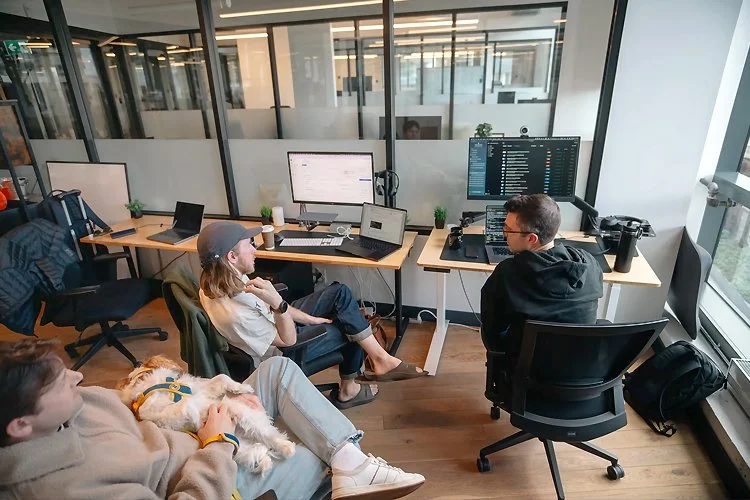
Modem employees working at the company’s office in Liberty Village.
“My hope is that all these things will build on each other and snowball,” Vinegar says.
Vinegar's advice to new graduates who are interested in entrepreneurship is to join an early startup and gain exposure to many different areas of the business — often a necessity at a company with a small team.
“I built up a lot of skills at smaller companies where you just had to solve problems yourself,” he says.
His experience at Sentry, seeing it grow over the course of 10 years, was also pivotal in his entrepreneurial journey. He says: “When you get to work on a problem continuously for a long time, you develop expertise, and expertise is in high demand in the marketplace of skills.”
— Original story by Coby Zucker for A&S News.