
This event is organized by the Schwartz Reisman Institute for Technology and Society.
Note: Event details may change. Please refer to the Schwartz Reisman Institute’s event listing for the most current information.
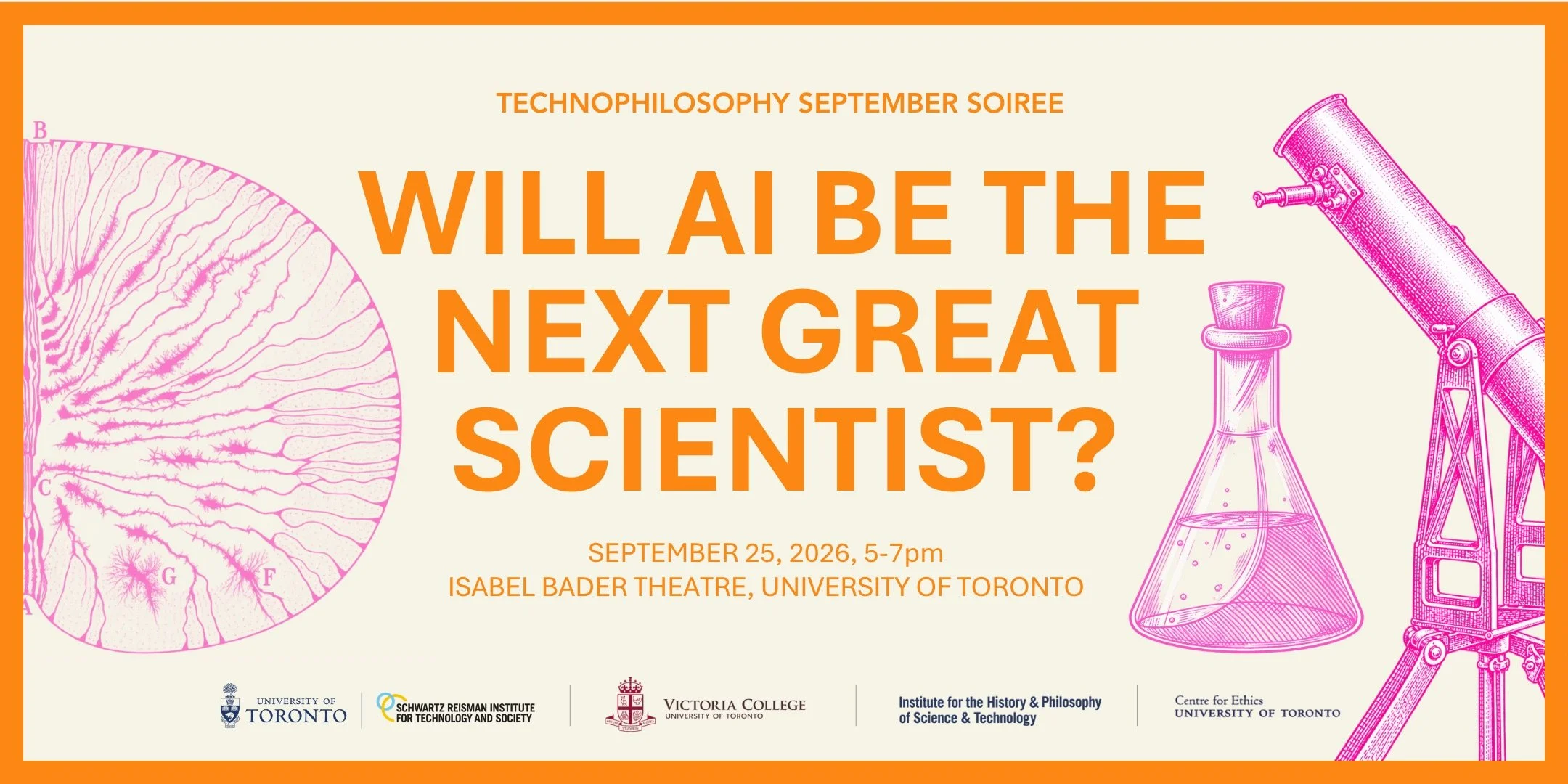
Artificial intelligence is rapidly becoming a powerful tool for scientific research—helping scientists analyze vast datasets, design experiments, generate hypotheses, and even discover new materials and medicines. But could AI fundamentally change how scientific discoveries are made?
Can an AI system genuinely make a discovery, or does discovery require human understanding? How will AI reshape the role of scientists and the scientific method itself? How can we ensure that these systems advance science without reproducing biases, obscuring uncertainty, or undermining public trust? Join us for an evening conversation exploring these questions.
The 2026 September Soiree on Technophilosophy will bring together leading thinkers from neuroscience, chemistry, computer science, and philosophy. “Technophilosophy” asks philosophical questions about technology—and considers how emerging technologies can help us answer enduring philosophical questions.
Together, Alán Aspuru-Guzik, Rosa Cao, Kathleen Creel, Sina Fazelpour, and Karina Vold will explore the promises, limits, and ethical implications of AI in scientific research and discovery.
Join us at the Isabel Bader Theatre, next to the Museum Subway Station. Food, beverages, and thought-provoking discussion provided.
Event details:
Venue: Isabel Bader Theatre, 93 Charles St W, Toronto, ON M5S 2C7
This is a special in-person only event.
Schedule:
Registration & pre-event reception: 4:30 p.m.
Event start: 5:30 p.m.
Students: Register for free with code IHPST
For more information please visit technophilosophy.ca.
Speakers:
Karina Vold, associate professor, Institute for the History & Philosophy of Science & Technology, University of Toronto; research lead, Schwartz Reisman Institute for Technology and Society
Alán Aspuru-Guzik, professor, Department of Chemistry and Department of Computer Science, University of Toronto; director, Acceleration Consortium; CIFAR Fellow
Rosa Cao, associate professor, Department of Philosophy, Stanford University
Kathleen Creel, associate professor, Department of Philosophy and the Weinberg Institute for Cognitive Science, University of Michigan
Sina Fazelpour, associate professor, Department of Philosophy and Khoury College of Computer Sciences, Northeastern University
Event partners:
Schwartz Reisman Institute for Technology and Society, University of Toronto
Institute for the History & Philosophy of Science & Technology, University of Toronto
Centre for Ethics, University of Toronto
Victoria College, University of Toronto
About the Schwartz Reisman Institute
Located at the University of Toronto, the Schwartz Reisman Institute for Technology and Society’s mission is to deepen our knowledge of technologies, societies, and what it means to be human by integrating research across traditional boundaries and building human-centred solutions that really make a difference. The integrative research we conduct rethinks technology’s role in society, the contemporary needs of human communities, and the systems that govern them. We’re investigating how best to align technology with human values and deploy it accordingly. The human-centred solutions we build are actionable and practical, highlighting the potential of emerging technologies to serve the public good while protecting citizens and societies from their misuse. We want to make sure powerful technologies truly make the world a better place — for everyone.