
Speaker:
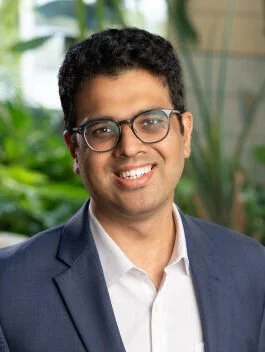
Swamit Tannu
Assistant Professor
University of Wisconsin-Madison
Talk Title:
Building the FTQC Stack: Architectural Principles for Performance and Scalability in Fault-Tolerant Quantum Computing
Date and Location:
Tuesday, September 15, 2026
3–4 p.m.
BA 7231
There is no registration required to attend this event in person. However, seating is limited, so arriving early is recommended.
Abstract:
Fault-tolerant quantum computing (FTQC) promises computational capabilities far beyond what noisy intermediate-scale devices can achieve, but realizing this promise demands more than a working error-correction code — it requires a full systems stack engineered for performance. The fundamental challenge is captured in a simple equation: Execution Time = Cycle Time × Cycles per Gate × Number of Gates. Each term conceals a distinct class of architectural and compiler bottlenecks that, left unaddressed, will prevent FTQC systems from scaling to practically meaningful problem sizes.
This talk presents a line of work that attacks all three terms simultaneously. For cycle time, we developed hardware-efficient readout and inference architectures for both superconducting and neutral-atom platforms that tighten the quantum error-correction loop without sacrificing fidelity. For cycles per gate, we identified and resolved hidden parallelism bottlenecks — synchronization overhead, leakage errors, and bursty QEC decoding latency — through co-designed control, classification, and virtualized decoding infrastructure. For gate count, we developed direct unitary synthesis techniques and compiler generation methods that cut T-gate and Clifford counts at the source, reducing the dominant fault-tolerant resource before it ever reaches the hardware.
Taken together, these contributions reframe FTQC not as an abstract fault-tolerance model but as a realizable systems engineering challenge — one that demands the same discipline in capacity planning, resource scheduling, and compiler design that has shaped classical computer architecture. I will discuss the unifying design principles behind this work, practical adoption by industry partners, and open problems that remain on the path to scalable FTQC.
Biography:
Swamit Tannu is an Assistant Professor in the Computer Sciences Department at the University of Wisconsin-Madison, where he leads QUEST lab. His research interests include computer architecture and quantum computing. Swamit's research focuses on developing architectural and systems abstractions for quantum computers. Swamit received the NSF CAREER award, Stamatis Vassiliadis best paper award at Computing Frontiers, and was inducted in MICRO Hall of Fame. Before joining the University of Wisconsin-Madison, Swamit received Ph.D. (2020) and M.S. (2018) both in Electrical and Computer Engineering from Georgia Tech.