
Note: Event details may change. Please refer to the University of Toronto Robotics Institute’s events page for the most current information.
Speaker:
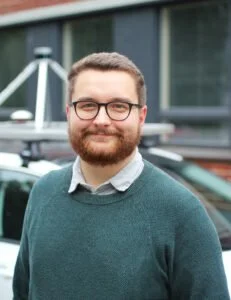
Risto Ojala
Talk title:
Perception solutions for enabling automated driving in winter conditions
Date: Friday, April 17, 2026
Time: 3-4 p.m.
Location: MY580 and Online via Zoom
Abstract:
This talk presents methods and findings from research on perception solutions for automated driving in winter conditions, carried out at the Autonomy & Mobility Laboratory, Aalto University. Winter conditions pose several challenges for automated vehicle perception pipelines, which currently limit the applicability of the technology in adverse weather conditions. The talk focuses on two main research directions: denoising snowflakes from LiDAR data and road segmentation in snowy conditions. Airborne snowflakes introduce significant noise into LiDAR scans, which can hinder downstream perception tasks. To address this challenge, the talk presents deep learning approaches for point cloud denoising based on both supervised and self-supervised learning. In addition, snowy conditions drastically alter the visual appearance of the environment and the road, rendering road segmentation methods trained on traditional datasets unreliable. To overcome this, trajectory-based approaches leveraging vision foundation models are presented for learning varied road appearance without requiring manual labeling.
Bio:
Risto Ojala (DSc, Tech) is an Assistant Professor at Aalto University, Finland, where he leads the Autonomy & Mobility Laboratory within the Mechatronics research group. His research focuses on intelligent vehicles and mobile robotics, with particular emphasis on perception, sensor fusion, and applied machine learning for autonomous systems. He is also currently a Visiting Scholar at Simon Fraser University, Canada, collaborating with the Multi-Agent Robotic Systems Laboratory on research in semantic understanding for mobile robotics. His work develops perception solutions that enable robust autonomous operation in challenging environments. A central application of his research is automated driving in winter conditions, addressing problems such as scene understanding, situational awareness, and perception reliability. His work has been published in leading robotics and intelligent transportation venues and he collaborates closely with both academic and industrial partners.