
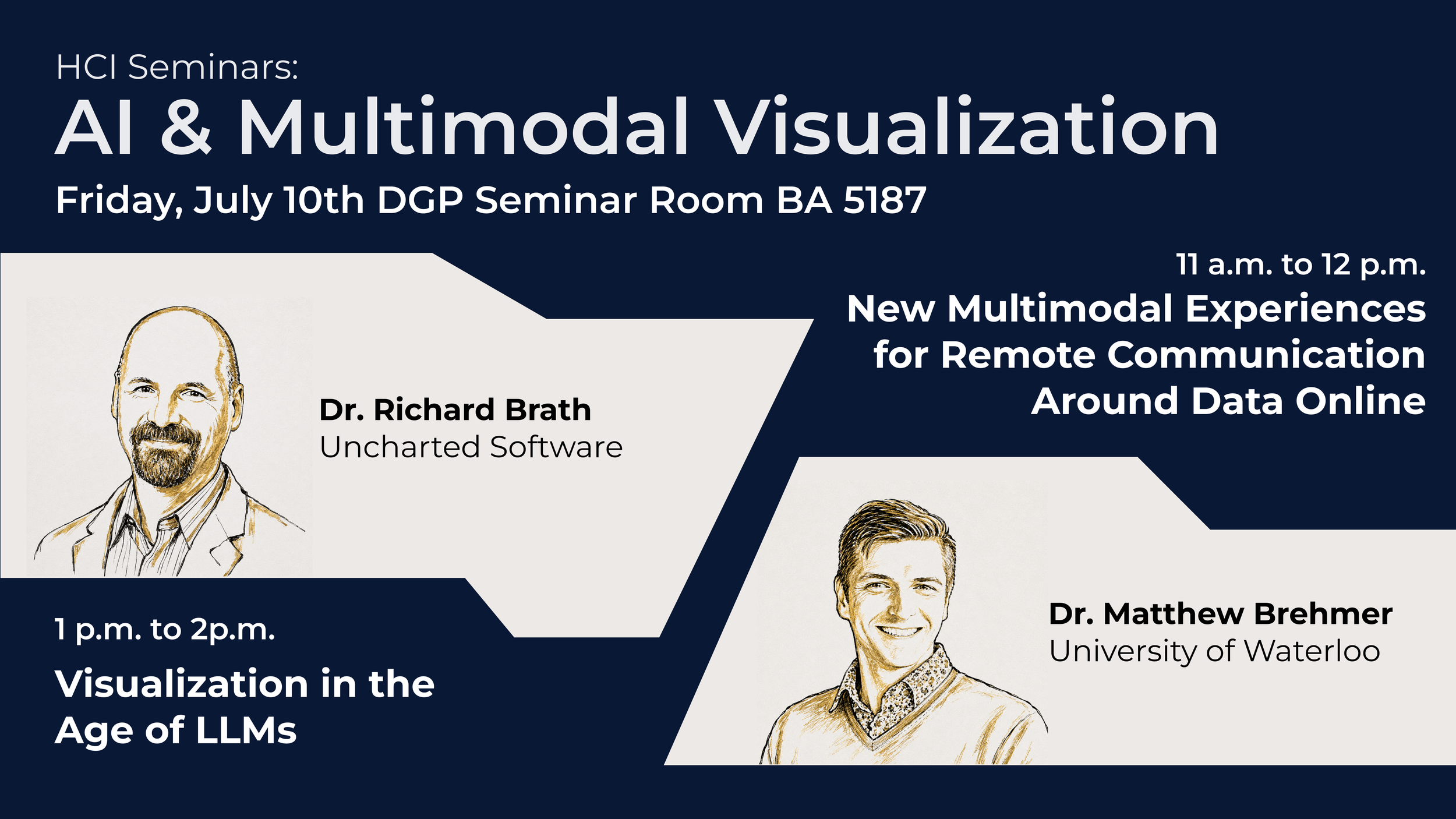
New Multimodal Experiences for Remote Communication Around Data
Matthew Brehmer (University of Waterloo)
Time: 11 a.m. to 12 p.m.
Abstract
There exists a spectrum of scenarios that involve communication and collaboration around data, varying in terms of formality, the number of participants, their role / expertise diversity, whether the experience is synchronous or asynchronous, and whether participants are co-located or distributed. In this talk, I will introduce a series of projects that explore new ways of presenting and interacting with data across these scenarios. One thread of projects operates within the medium of augmented reality video, initially motivated by the pivot to remote work during the pandemic and the limitations of videoconferencing tools for presenting data. Our approach involves superimposing visual representations of data over webcam video and manipulating these visuals via continuous bimanual hand tracking. Another thread of projects proposes ways of surfacing representations of data in conversational side channels, in which we consider aspects such as glanceability, ephemerality, and relevance to the current discussion. Beyond these two threads, I will also discuss open research challenges in remote collaboration involving visualization, which include technological and social challenges as well as those relating to the integration of AI in these scenarios and the logistical difficulties of evaluating techniques and applications dedicated to these scenarios.
Bio
Matthew (Matt) Brehmer is a human-computer interaction (HCI) researcher focusing on information visualization: he designs, implements, and evaluates new ways to communicate and collaborate around data. In Fall 2024, he joined the school of computer science at the University of Waterloo as an Assistant Professor, where he is a member of the HCI lab and the director of the ubietous* information experiences research group. Prior to joining Waterloo, Matt spent the better part of the last decade in industry research settings, most recently as a Lead Researcher at Tableau Research in Seattle, and before that, a member of the EPIC HCI research group at Microsoft Research. His work has been recognized with Test of Time and Best Paper Awards at IEEE VIS as well as Honorable Mentions at IEEE VIS and ACM UIST. He has a PhD and MSc in Computer Science from the University of British Columbia in Vancouver, and a Bachelor of Computing specializing in Cognitive Science from Queen’s University. You can learn more about his work at mattbrehmer.ca and about his group at ubixgroup.ca.
* ubiety is the quality or state of being in a place … if ubiquitous computing is defined as computation in all places at all times, ubietous computing is the right computation in the right place at the right time. The ubix group is interested in ubietous representations of information: those which manifest at the right place and time, in the right modalities and form factors for the activities at hand.
Visualization in the Age of LLMs
Richard Brath (Uncharted Software)
Time: 1–2 p.m.
Abstract
LLMs change what visualization is and how we use it. Thread one is visualization generally. LLMs fit into every step in visualization: data collection, enrichment, analysis, visualization design and generation, UX, workflows, and narratives. Thread two focuses on the designer. LLMs change what is feasible as computationally created visualizations. We can create insights, make diagrams, perform semantic encoding, and generate narratives. I reflect on 55 novel visualizations I’ve created over 12 years and how LLMs have aided design space exploration: reducing coding effort, enabling new design opportunities, and causing shock, excitement, accomplishments, and other shifts to the design process. Thread three focuses on the user and automated visual analytics: as a user, I want answers faster. In the context of a large graph visual analytics system we created, interaction for human users is challenging due to hundreds of thousands of nodes, thousands of filterable categories, and many analytic models. LLMs facilitate the creation and interpretation of answers with transparency across the process, tools, sources, and validation.
Bio
Richard Brath is a managing partner at Uncharted Software, designing and building visualizations for expert users in application areas such as financial markets, supply chains, and customer journey analytics. We augment human insight gathering with machine reasoning using highly visual, interactive techniques for some of the world’s largest data-driven companies and for innovative startups. Richard authored Visualizing with Text (CRC 2021), advocating visualization for qualitative textual data. This position has been extended to leverage LLMs for data collection, featurization, introspection, design ideation, and analysis.